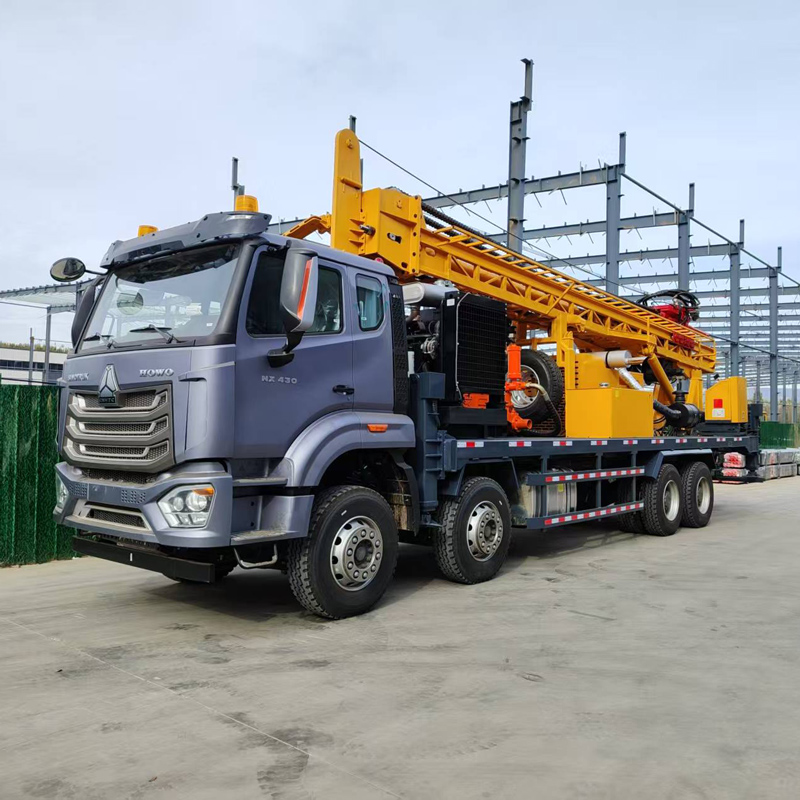
Truck-Mounted Water Well Drilling Rig
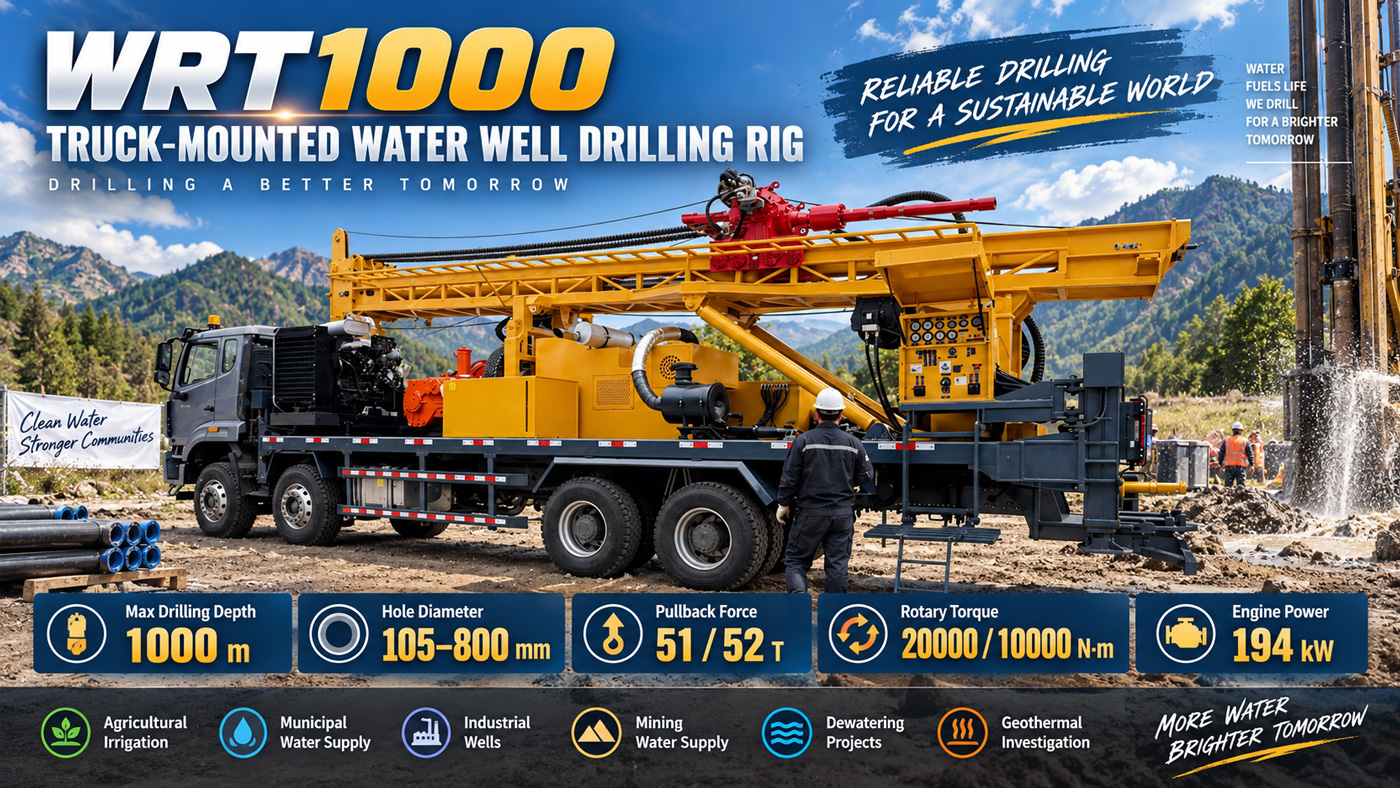
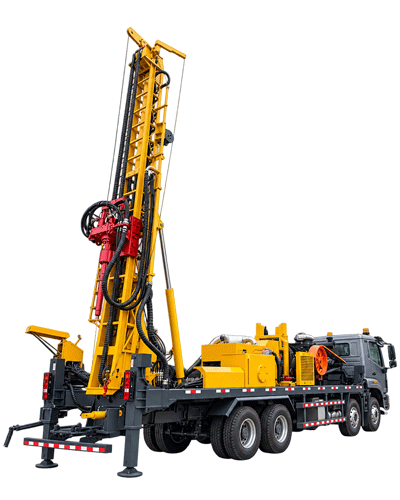
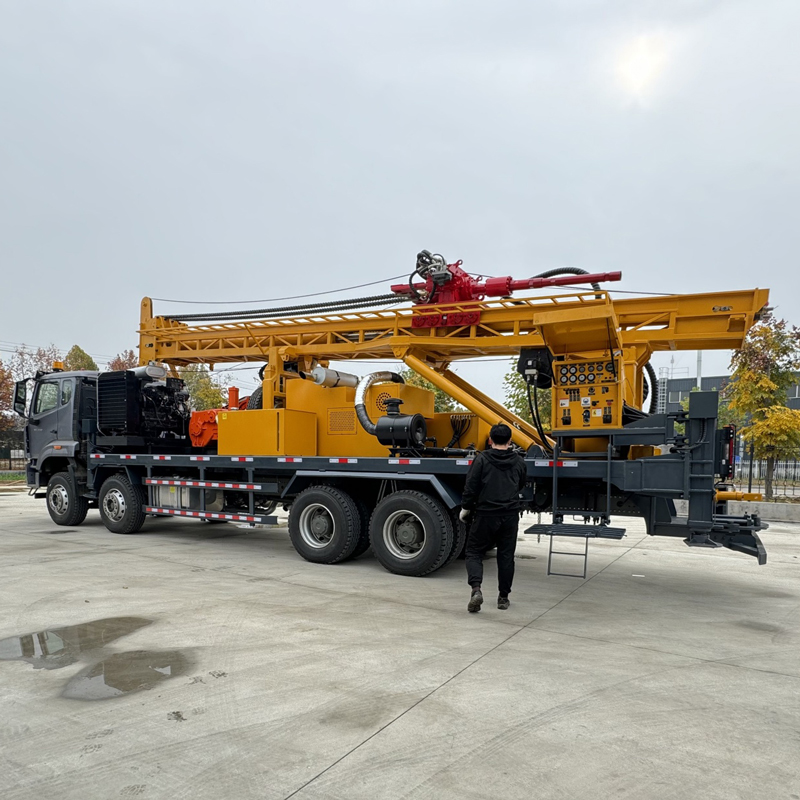
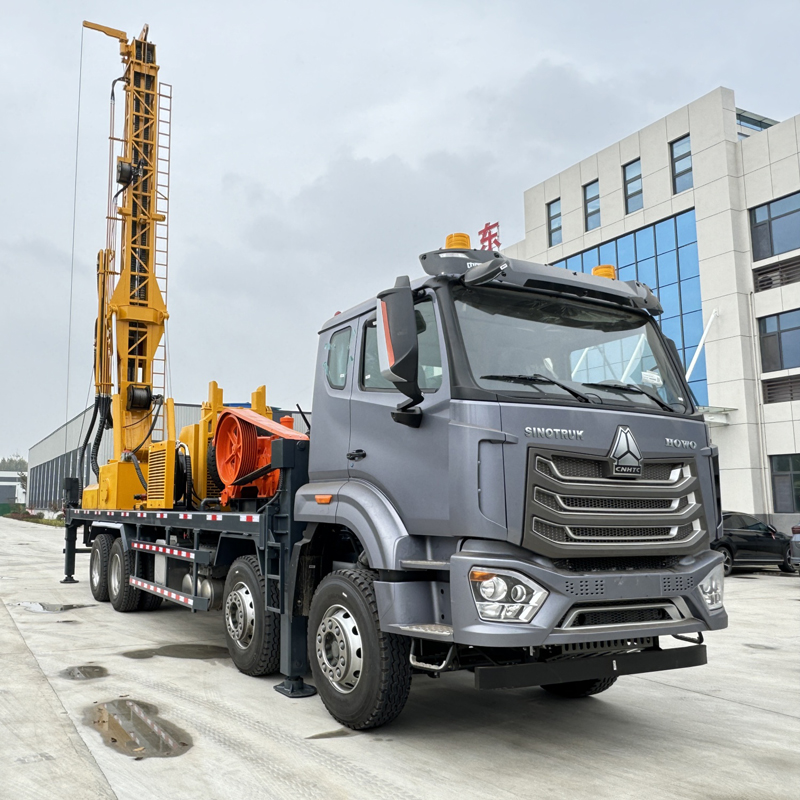
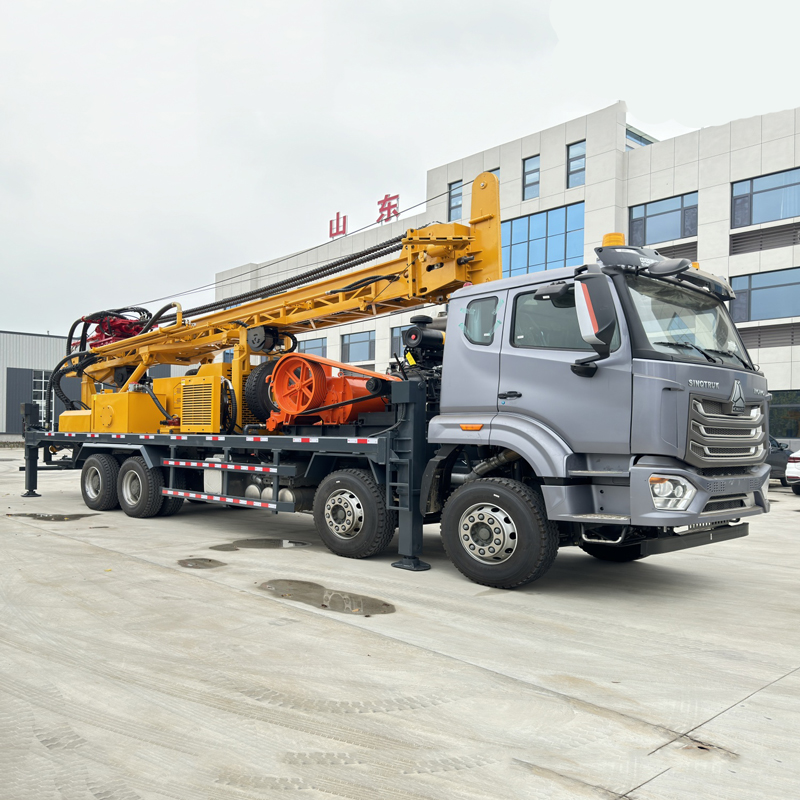
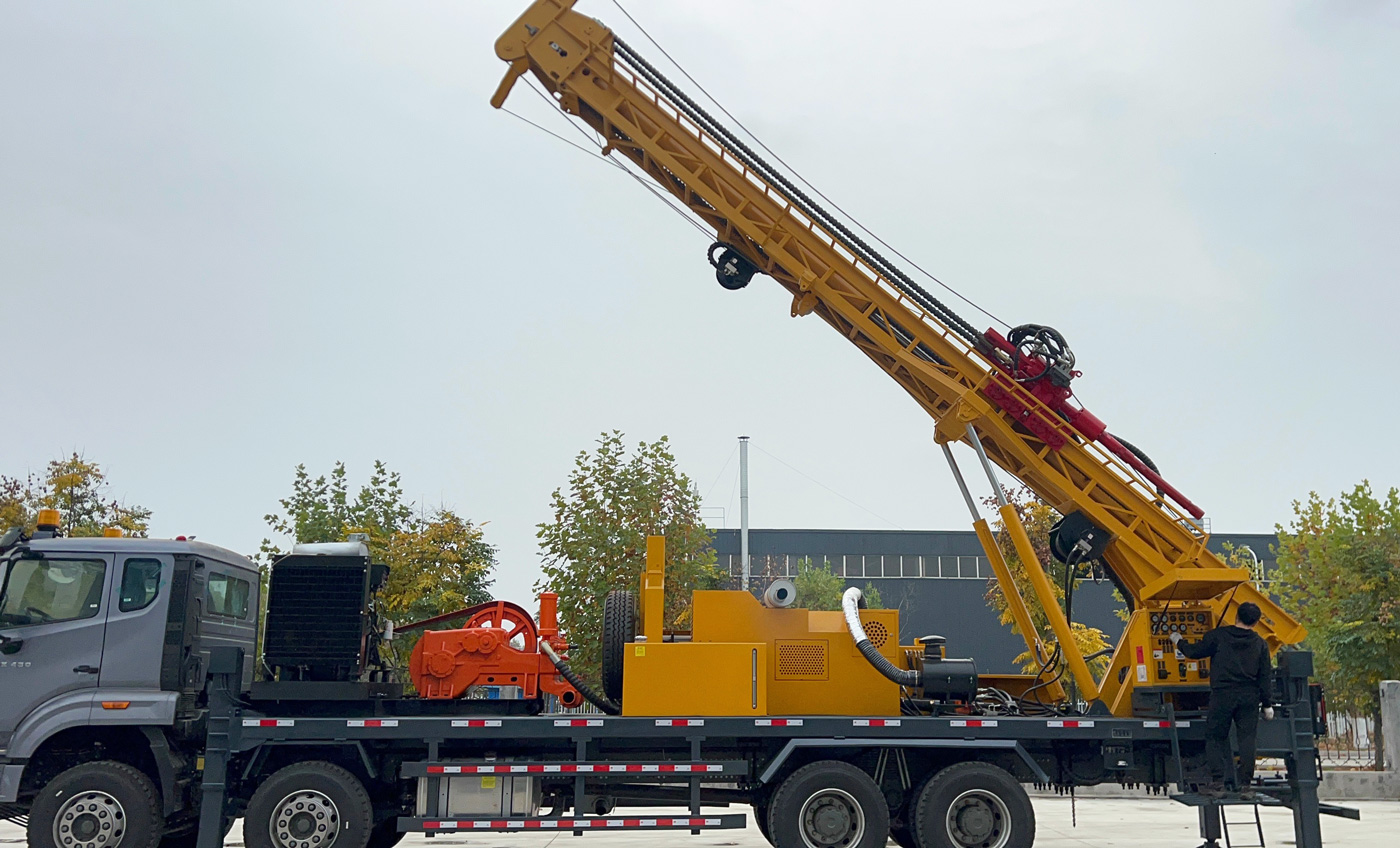
The WRT1000 is a heavy-duty truck-mounted fully hydraulic water well drilling rig designed for 1000-meter deep water wells, large-diameter groundwater development, and complex formation construction. The entire machine adopts a straight-mast structure, integrating the mast, power head, hydraulic feed, dual auxiliary winches, and operating system on a truck chassis. It has a maximum drilling depth of 1000 m, a drilling diameter of 105–800 mm, 51/52 T lifting force, 20000/10000 N·m dual-condition rotary torque, and 194 kW diesel power. It is suitable for mining water supply, industrial water, agricultural irrigation, dewatering, and geothermal survey projects.
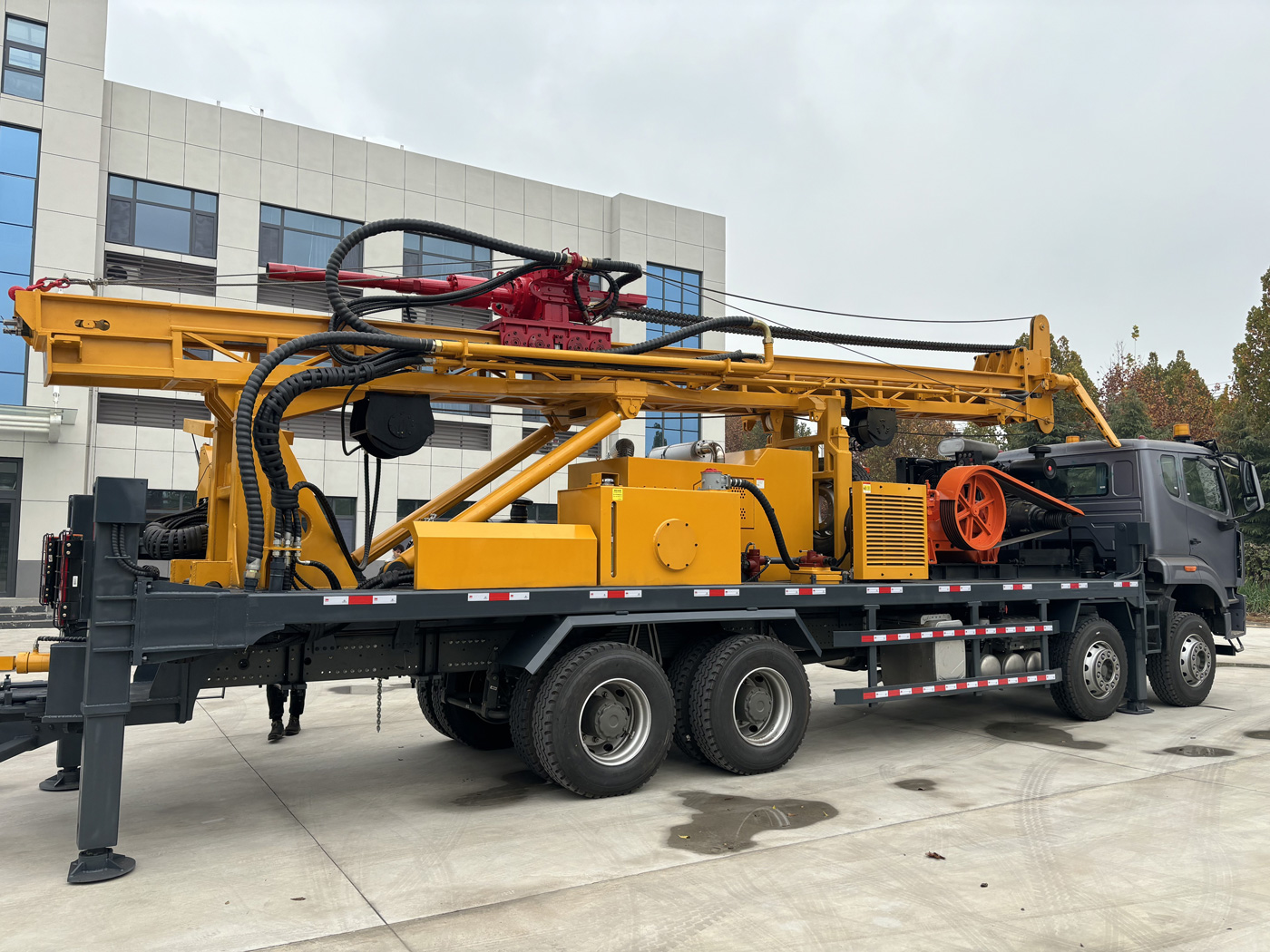
One of the main advantages of the WRT1000 is that the heavy-duty drilling system is directly mounted on a truck platform. For mining areas, farms, industrial parks, and cross-regional drilling projects, the equipment can be transferred by road to the next construction site after completing one hole, without the need to repeatedly arrange flatbed truck loading and unloading as with crawler drilling rigs. This is especially suitable for professional construction teams with scattered drilling points and frequent relocations.
This model uses a straight mast rather than a telescopic mast. The straight-mast structure has a more direct force path, making it suitable for long-term high-torque rotation, deep-hole drill pipe handling, and casing operations. For 1000-meter water wells, mast stability directly affects drill string operation, hole deviation control, and high-load construction. Therefore, the straight mast is more oriented toward continuous deep-hole operations rather than compressing the transport profile.
The maximum drilling depth of 1000 m enables the WRT1000 to cover deep groundwater development that ordinary 300–600 meter equipment cannot handle. For scenarios where shallow aquifers are unstable, mining areas need to find deeper water sources, industrial projects require long-term stable water supply, or geothermal surveys need deeper formation verification, the 1000-meter drilling depth provides greater construction margin.
The drilling diameter range of 105–800 mm can accommodate conventional water wells, large-flow water supply wells, and some large-diameter engineering holes. Larger diameters are suitable for larger well casings and pump types, but increased diameter will simultaneously increase drilling tool load, air compressor demand, casing weight, and hole completion difficulty. Therefore, the actual project should reasonably select the hole diameter based on water yield and well completion structure.
At 1000-meter hole depths, the self-weight of drill pipes, casing weight, and borehole wall friction all increase significantly. The WRT1000 provides 51/52 T lifting force and 11 T axial pressure, which can be used for deep-hole tripping, DTH hammer recovery, some casing operations, and abnormal hole section tool handling. When encountering continuously rising tripping resistance, the hole should be cleaned first and the downhole condition assessed, rather than directly relying on maximum lifting force to pull forcefully.
The rotary system has a maximum torque of 20000/10000 N·m, corresponding to a 70/140 r/min dual-speed configuration. Low speed and high torque are more suitable for large diameters, hard rock, and high-friction hole sections, while the high-speed gear is suitable for stable formations with less resistance. Deep-hole construction should dynamically adjust working conditions based on rotary load, cuttings return, and drilling tool wear.
The feed stroke is 7 m, and 3 m or 6 m drill pipes can be used, with a recommended drill pipe diameter of 114 mm. The 6 m drill pipe is suitable for long-cycle deep-hole construction, reducing the number of pipe connections; the 3 m drill pipe is more suitable for sites with limited space, transportation, or manual operation conditions. The fast lifting speed of 28 m/min and fast advancing speed of 42 m/min are mainly used for non-drilling actions.
The recommended working air pressure for DTH down-the-hole drilling is 1.65–8 MPa, with air consumption of 16–96 m³/min. 1000-meter deep holes and large-diameter hard rock have very high requirements for air compressor pressure and displacement. When selecting, a comprehensive judgment should be made based on DTH hammer specifications, hole diameter, hole depth, altitude, and rock hardness, not just the rated pressure.
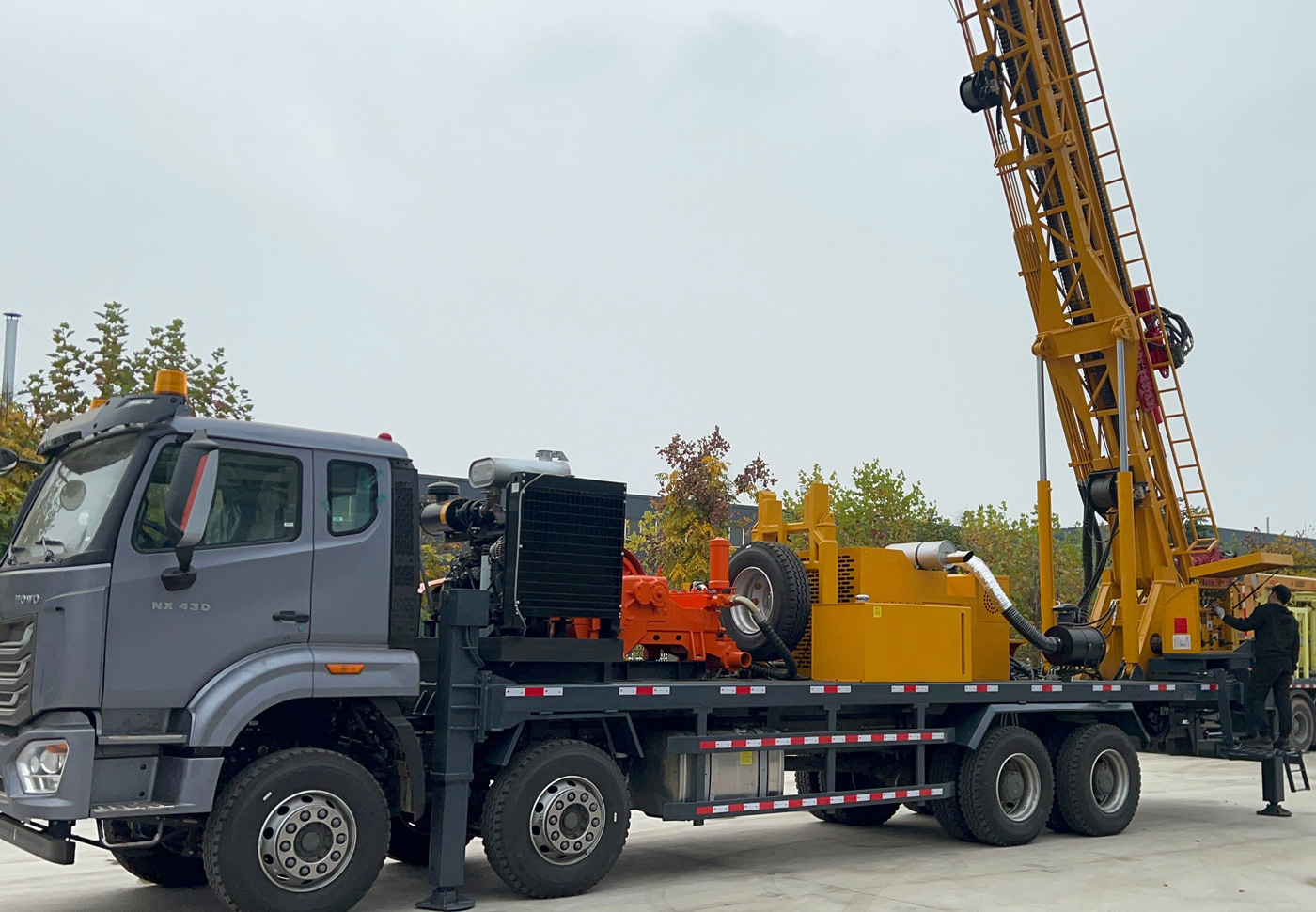
After entering relatively complete rock formations such as limestone, sandstone, and granite, medium and high air pressure DTH hammers can be configured for DTH drilling. Hard rock deep-hole construction should ensure DTH hammer lubrication, drill bit condition, and continuous hole cleaning; if cuttings return decreases, air pressure fluctuates, or rotary resistance is abnormal, timely judgment should be made for air leakage, bottom hole cuttings accumulation, or drill bit wear.
Upper loose formations can use mud rotary drilling, casing, or other hole stabilization methods. For 1000-meter deep wells, the stability of the upper hole section is particularly important, because once early collapse, diameter reduction, or casing problems occur, the risk and treatment cost of subsequent deep-hole construction will increase significantly.
Many deep wells will experience continuous changes from loose overburden, weathered rock, fractured zones, and complete rock formations. The WRT1000 can use mud or casing to stabilize the hole in the upper section, and then switch to DTH after entering stable hard rock. Construction in fractured zones should reduce advancement, strengthen hole cleaning, and promptly handle falling blocks and diameter reduction according to borehole wall conditions.
After entering the main aquifer, increased water inflow in the hole will affect DTH hammer cuttings discharge and circulation status. During construction, the depth of the main water-producing layers should be recorded, and the air supply, hole cleaning, and casing plan should be adjusted according to the water inflow. During the well completion stage, filter pipes, water stop sections, and the final pump type should be set in combination with the aquifer distribution.
In suitable rock formations, pneumatic DTH drilling has low dependence on large amounts of mud water, making it suitable for arid mining areas, remote agricultural, and water-scarce construction sites. The truck-mounted structure also facilitates transfer between multiple distant drilling points, making the WRT1000 more suitable for large-scale groundwater development projects.
For farmland, large farms, and pastoral areas with deep groundwater levels, the WRT1000 can be used for deep irrigation wells and livestock water supply wells. Different projects should determine the final well diameter and depth based on aquifer thickness, expected water yield, pump type, and well casing size.
Villages, communities, and public facilities can use the WRT1000 to develop deep groundwater. For long-term water supply projects, hydrogeological surveys and water quality assessments should be completed before drilling to determine the target aquifer, rather than simply constructing according to the equipment's maximum drilling depth.
Factories, industrial parks, and large construction camps can use the WRT1000 to construct production auxiliary water wells, domestic water supply wells, and equipment cleaning water wells. The large-diameter capability and deep-hole configuration provide greater well completion space for high-flow water supply projects.
The WRT1000 is suitable for mining camp water supply, dust suppression, equipment cleaning, and auxiliary production water, and can also undertake some mine dewatering holes according to hydrological design. Mining area road conditions are complex, and before entering the site, it is necessary to confirm the road passage, slope, turning, and platform bearing conditions of the truck chassis.
The 1000-meter drilling depth is also suitable for some geothermal surveys, temperature gradient holes, and deep geological verification. Geothermal projects also need to consider formation temperature, casing grade, circulation medium, and cementing requirements. Formal geothermal development wells should be equipped with drilling tools and well completion systems according to special design.
The equipment is equipped with a 4 T large auxiliary winch and a 3 T small auxiliary winch, which can be used for handling DTH hammers, drill pipes, casings, air pipes, and on-site accessories. 1000-meter deep-hole projects have more and heavier supporting tools, and dual winches help reduce manual handling and improve drilling site organization efficiency.
The equipment is equipped with a 194 kW diesel engine to provide power for rotation, feed, winches, and auxiliary systems. During long-term hard rock and deep-hole construction, focus should be on maintaining engine cooling, air filtration, and fuel systems. For dusty sites, the frequency of filter element and radiator cleaning should be increased.
The overall weight is approximately 26 T, and the transport dimensions are approximately 10.8 × 2.5 × 4.23 m. The truck-mounted structure improves road relocation efficiency, but the 4.23 m transport height means that before entering the site, road height restrictions, bridges, overhead lines, factory gates, and other overhead obstacles must be verified.
Before daily work, check the truck chassis, straight mast structure, hydraulic system, power head, winches, drill pipes, and high-pressure air pipes; during deep-hole construction, continuously observe air pressure, torque, cuttings return, water return, and tripping resistance; before relocation, the mast and working mechanisms must be restored to a safe transport state, and the equipment must be secured according to road transport requirements.
Due to differences in actual geological conditions, downhole tools, drilling angles, and operating methods, the final drilling efficiency, drilling depth, and well completion effect should be based on on-site conditions.
| Parameter Item | Parameter Value |
|---|---|
| Basic Parameters | |
| Product Model | WRT1000 |
| Equipment Type | Truck-mounted straight-mast water well drilling rig |
| Installation Form | Truck-Mounted |
| Mast Structure | Straight mast |
| Maximum Drilling Depth | 1000 m |
| Drilling Diameter | 105–800 mm |
| Drill Pipe and Feed System | |
| Drill Pipe Length | 3 / 6 m |
| Recommended Drill Pipe Diameter | 114 mm |
| Axial Pressure | 11 T |
| Lifting Force | 51 / 52 T |
| Fast Lifting Speed | 28 m/min |
| Fast Advancing Speed | 42 m/min |
| Feed Stroke | 7 m |
| Rotary System | |
| Maximum Rotary Torque | 20000 / 10000 N·m |
| Maximum Rotary Speed | 70 / 140 r/min |
| Pneumatic System Matching | |
| Recommended Working Air Pressure | 1.65–8 MPa |
| Recommended Air Consumption | 16–96 m³/min |
| Compatible DTH Hammer | Medium and high air pressure series |
| Auxiliary System | |
| Large Auxiliary Winch Lifting Force | 4 T |
| Small Auxiliary Winch Lifting Force | 3 T |
| Power and Overall Machine | |
| Engine Power | 194 kW |
| Power Form | Diesel power |
| Travel Mode | Truck chassis |
| Maximum Climbing Angle | 21° |
| Overall Weight | 26 T |
| Transport Dimensions | 10.8 × 2.5 × 4.23 m |
| Reference Drilling Efficiency | 10–35 m/h |
| Applicable Formations | |
| Soil and Clay | Mud rotary drilling can be used with casing for hole stabilization |
| Sand and Gravel Layers | Focus on controlling hole collapse, diameter reduction, and circulation loss |
| Weathered Rock | Adjust drilling method according to hardness and borehole wall stability |
| Fractured Rock | Reduce advancement, strengthen hole cleaning, and follow up with casing as appropriate |
| Complete Hard Rock | Medium and high air pressure DTH hammer drilling can be used |
| Drilling Methods | |
| Top Drive Hydraulic Rotary Drilling | Suitable for conventional deep water wells and large-diameter drilling |
| DTH Hammer Drilling | Suitable for weathered rock, fractured rock, and complete hard rock |
| Mud Rotary Drilling | Suitable for loose formations such as soil, clay, sand, and gravel layers |
| Optional Accessories | |
| Mud Pump | Optional |
| Centrifugal Pump | Optional |
| Generator | Optional |
| Foam Pump | Optional |
| Typical Applications | |
| Deep Water Wells | Rural, community, and large-scale groundwater development |
| Agricultural Irrigation | Large farms, orchards, and deep irrigation wells |
| Industrial Water Supply | Factories, industrial parks, and large engineering projects |
| Mining Water Supply | Mine domestic water, dust suppression, and auxiliary production water |
| Mine Dewatering | Open-pit mines, underground mining areas, and some engineering dewatering holes |
| Geothermal Projects | Temperature gradient holes and some geothermal survey boreholes |
We are a professional drilling equipment manufacturer specializing in the research and development, production and supply of water well drilling rigs, core drilling rigs, reverse circulation drilling rigs, down-the-hole drilling rigs, truck-mounted drilling rigs and mineral exploration equipment.
© 2026 Shandong Hengjianhang Construction Machinery Co., Ltd. All rights reserved.