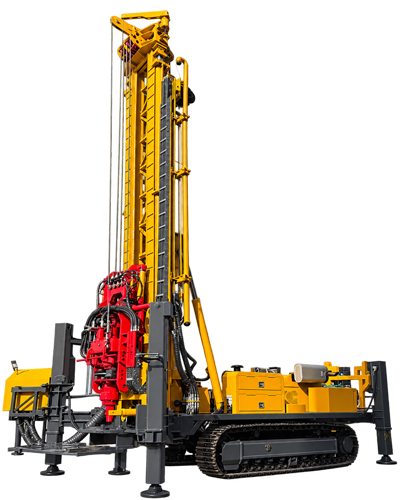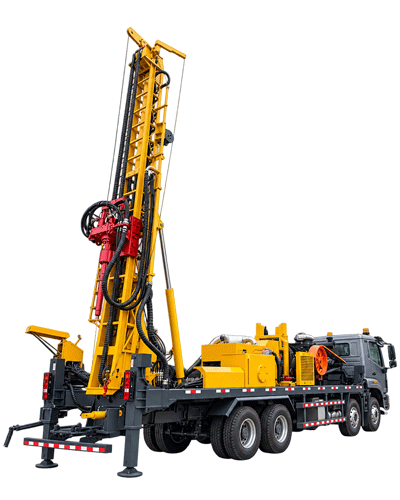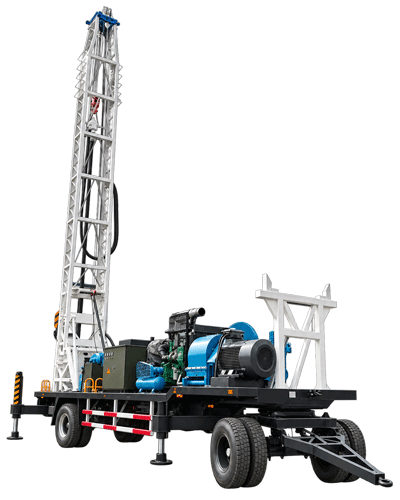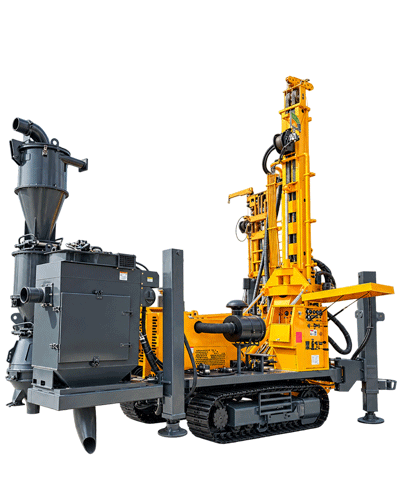
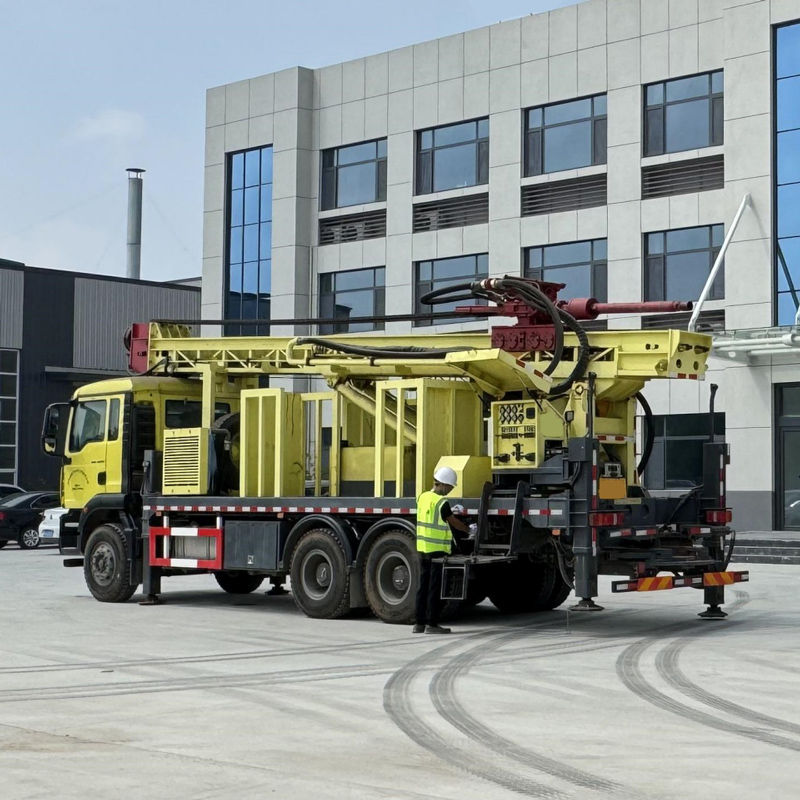
Truck-Mounted Water Well Drilling Rig
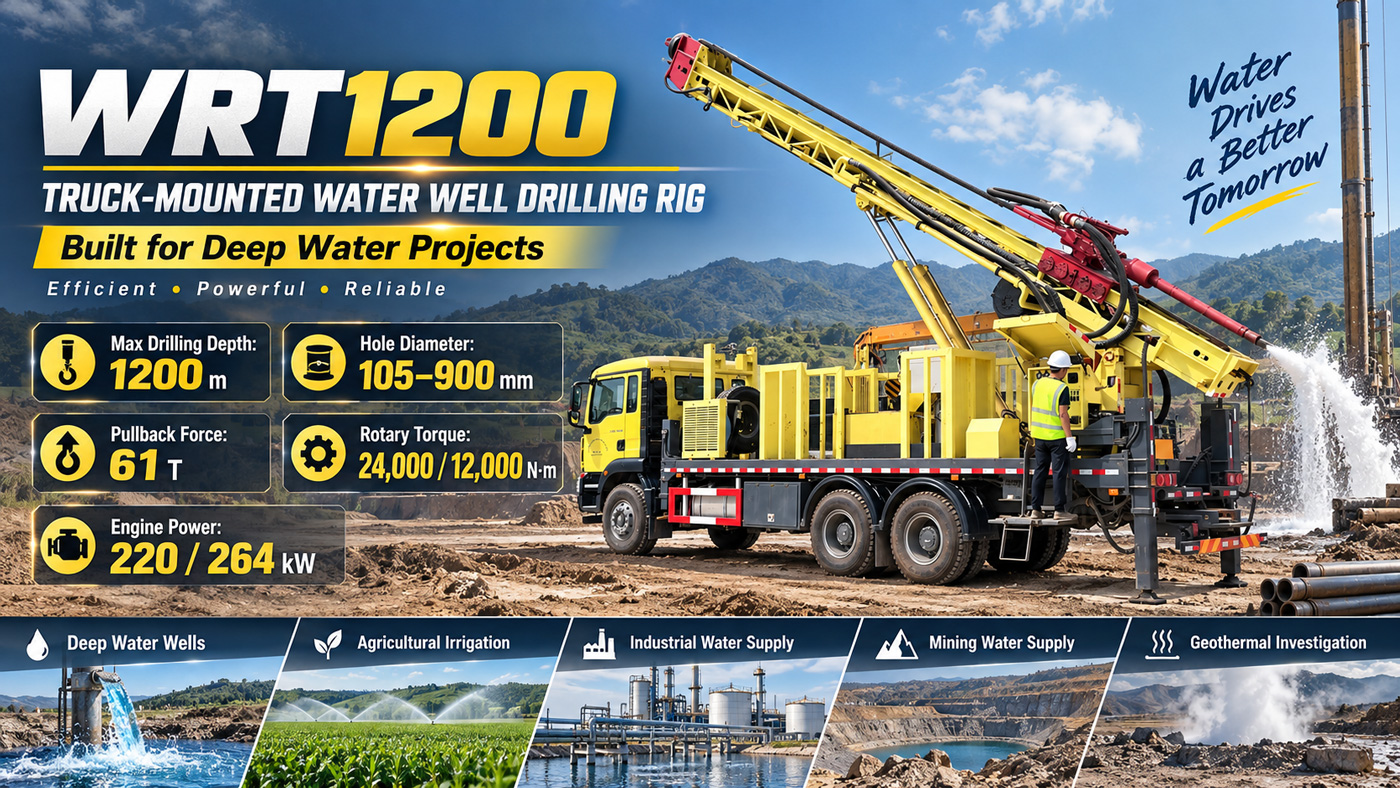
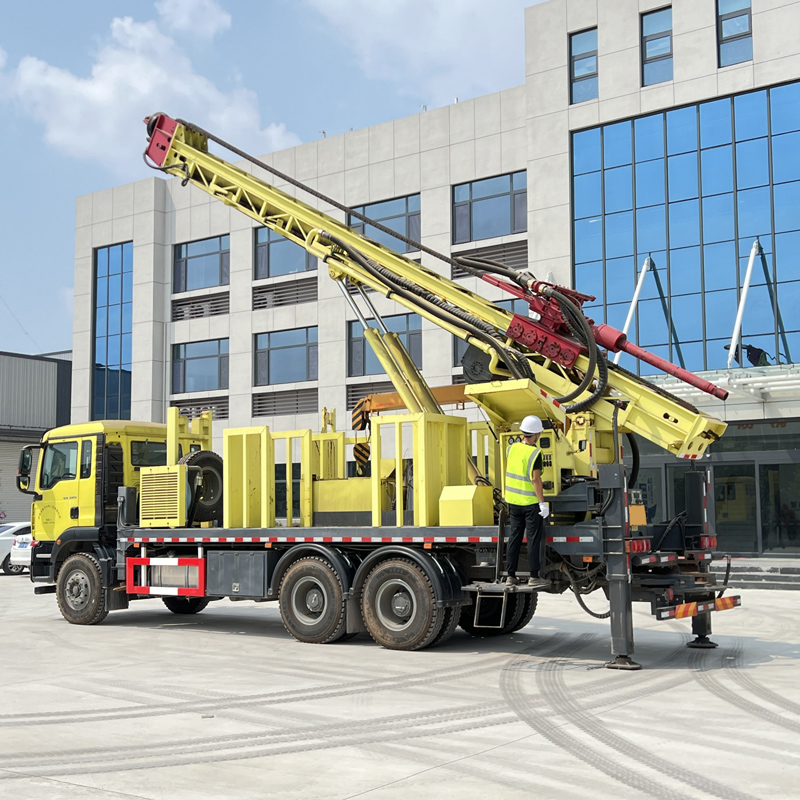
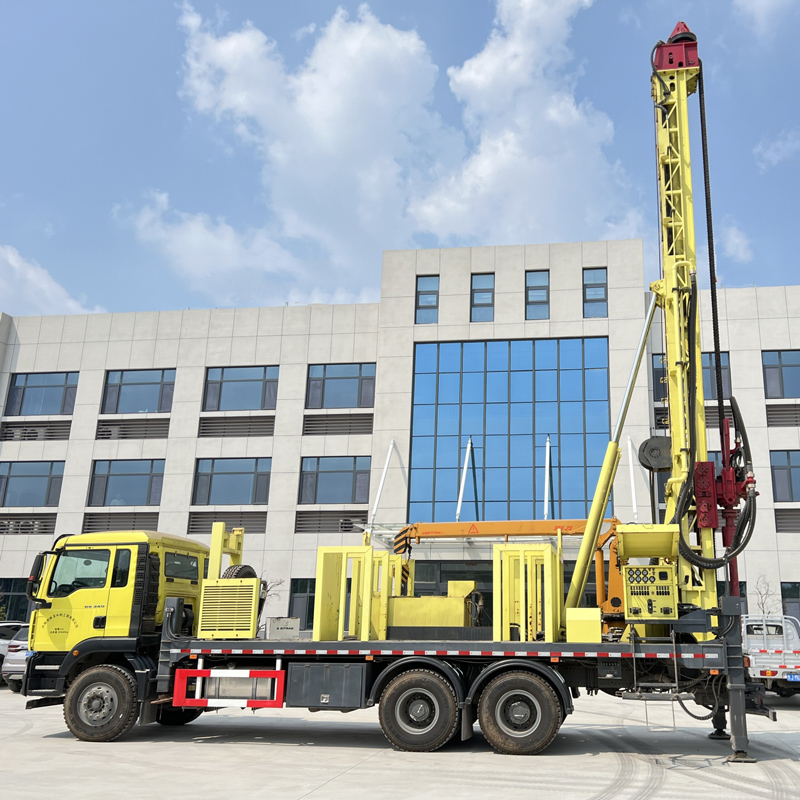
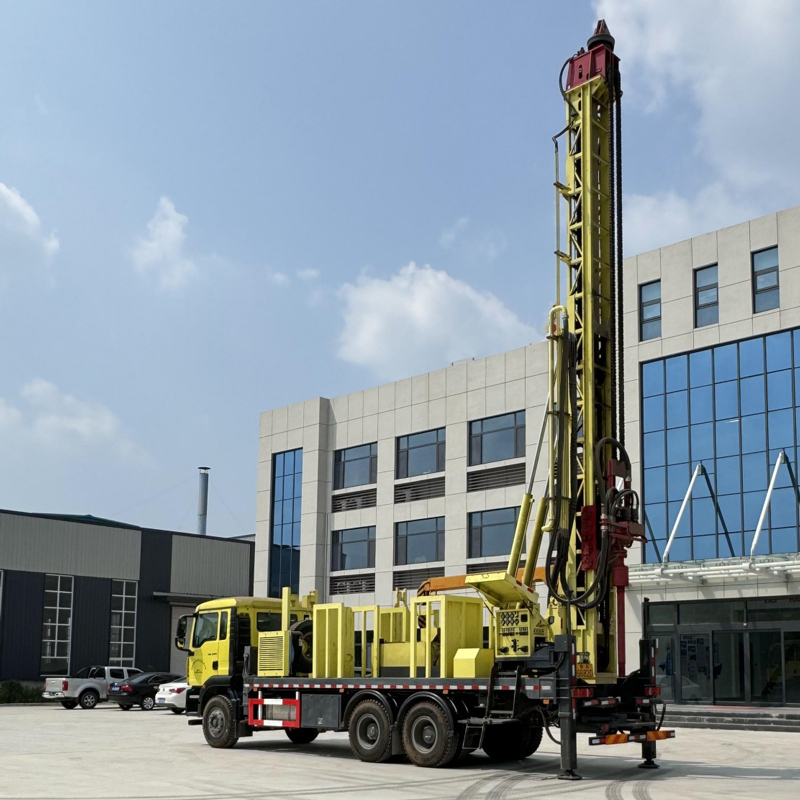
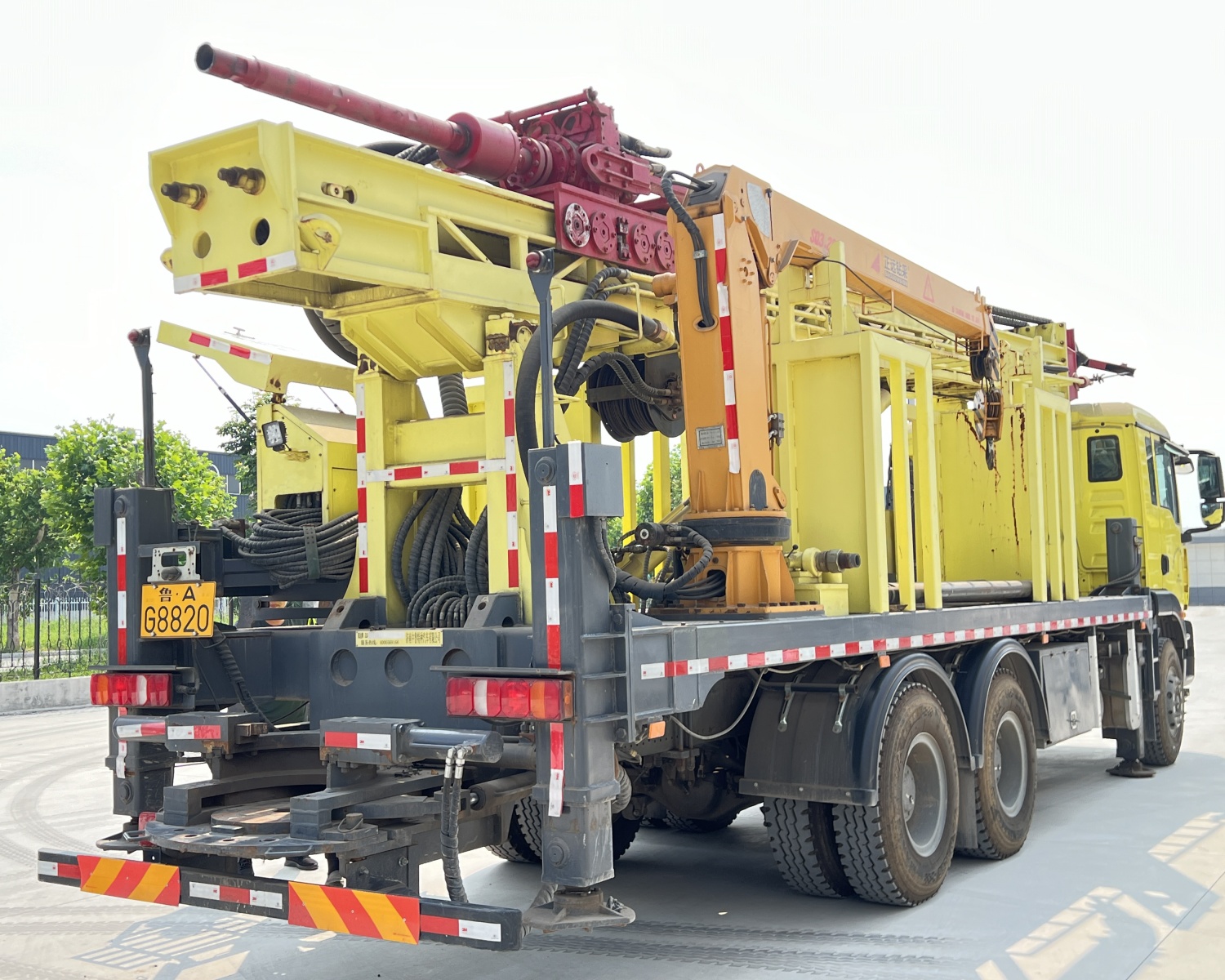
The WRT1200 is a heavy-duty truck-mounted fully hydraulic water well drilling rig designed for 1200 m-class ultra-deep water wells, large-diameter groundwater development, and complex formation construction. The whole machine adopts a straight-mast structure, integrating the mast, power head, hydraulic feed, dual auxiliary winches, and operating system on a truck-mounted chassis. It has a maximum drilling depth of 1200 m, a hole diameter of 105–900 mm, 61 T lifting force, 24000 / 12000 N·m dual-mode rotary torque, and 220 / 264 kW diesel power. It can be used for mining area water supply, industrial water, deep irrigation, engineering dewatering, and geothermal investigation projects.
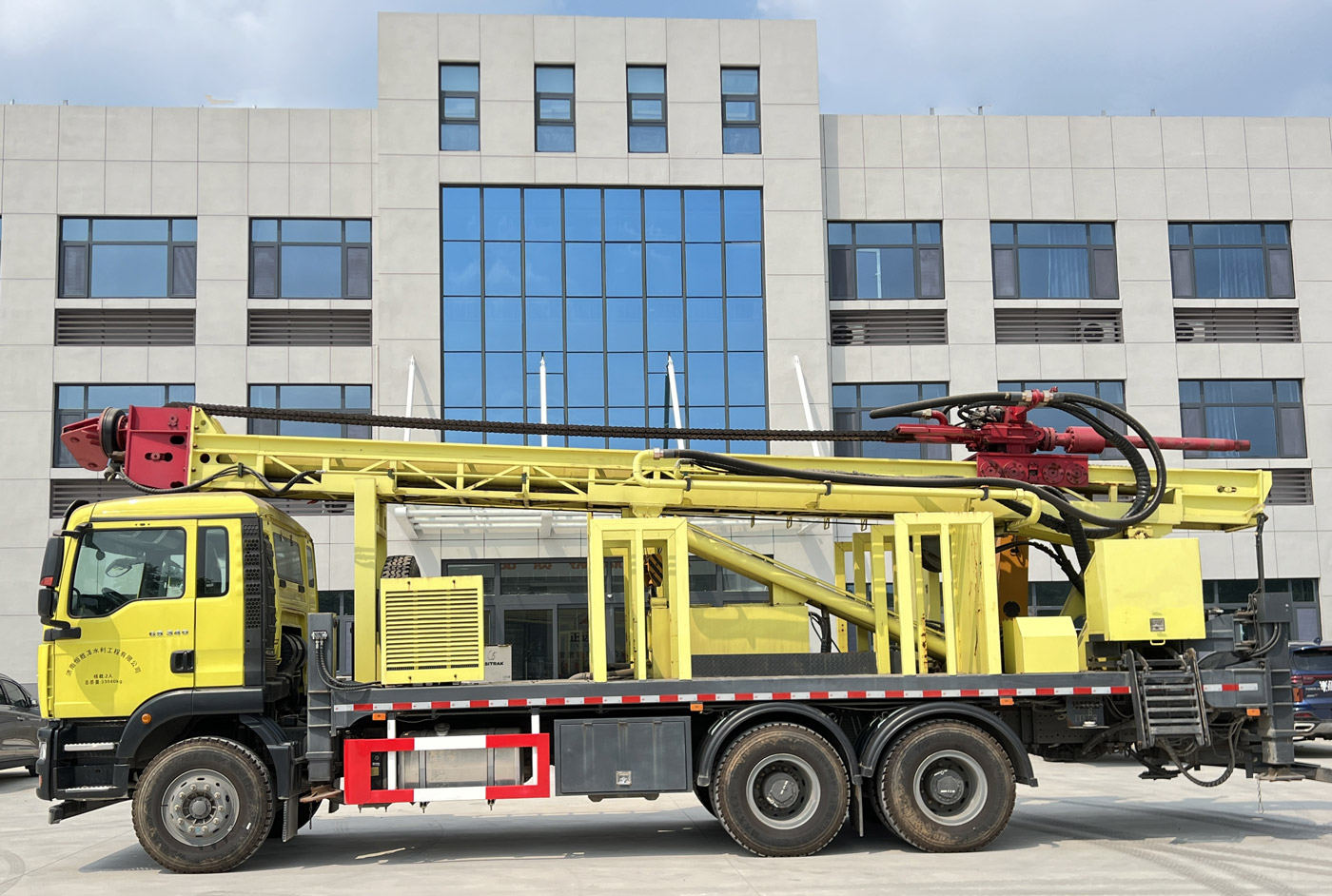
1200 m-class water well drilling rigs are usually large and have many supporting components. If they rely on flatbed trucks for frequent loading and unloading, the switching time between projects will increase significantly. The WRT1200 integrates the main drilling systems on a truck-mounted chassis, making it more suitable for road relocation between mining areas, industrial parks, farms, and different cities. For professional well drilling contractors, truck mounting can reduce repeated loading, unloading, and lifting organization costs.
The WRT1200 adopts a straight-mast structure rather than a telescopic mast. For 1200 m-class deep holes, the advantage of the straight mast is that the overall force path is more direct, making it suitable for long-term high-torque rotation, heavy drill string tripping, and casing operations. The trade-off is a more fixed transport profile, so road height limits, site access space, and site clearance should be confirmed before construction.
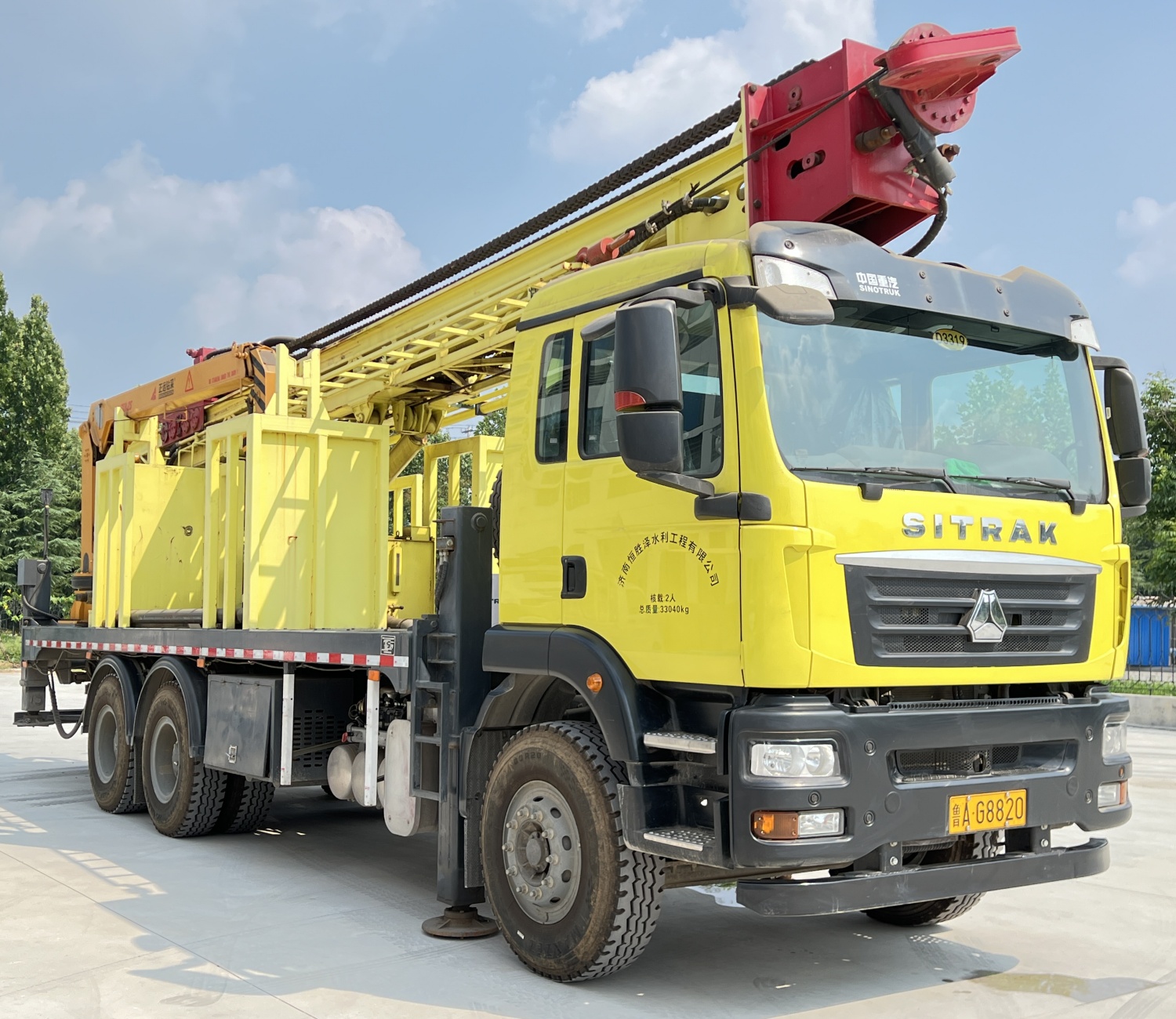
The maximum drilling depth of 1200 m enables the WRT1200 to cover deep groundwater projects that ordinary medium-deep well equipment cannot handle. For scenarios where shallow aquifers have insufficient water, mining areas need to find more stable water sources, industrial projects require highly reliable water supply, or geothermal investigation requires verification of deeper formations, the 1200 m-class depth reserve is of practical significance.
The drilling diameter range of 105–900 mm can cover conventional deep water wells to large-diameter groundwater wells. A larger diameter facilitates the configuration of larger well casings and submersible pumps, but it also increases drilling tool load, casing weight, cuttings removal requirements, and air compressor load. Therefore, the reasonable diameter should be designed according to water yield, well casing, and pump type in formal projects.
The lifting force is 61 T, and the axial pressure is 13 T. As hole depth increases, the self-weight of drill pipes, casing weight, and borehole wall friction will rise significantly. Higher lifting capacity is beneficial for deep-hole tripping, DTH hammer recovery, and some casing operations. If tripping resistance is abnormal, the hole should be cleaned first and the condition of the borehole wall, drilling tools, and sediment should be judged. The maximum lifting force should not simply be used to pull forcefully.
The rotary system has a maximum torque of 24000 / 12000 N·m, corresponding to a 75 / 150 r/min dual-speed configuration. Low speed and high torque are more suitable for large-diameter, hard rock, and high-friction hole sections, while the high-speed gear is suitable for stable formations with less resistance. During construction, the working mode should be switched in time according to drilling tool load, cuttings return, and torque changes.
The data gives a thrust/feed stroke of 7 / 13 m, which can be selected according to the final configuration. A longer stroke can reduce the frequency of power head return and drill pipe handling, making it more suitable for deep-hole projects pursuing continuous drilling efficiency; the 7 m configuration is easier to balance overall structure and site adaptability. The formal configuration should be based on the technical confirmation data provided at delivery.
The recommended drill pipe diameter is 127 mm, and the drill pipe length supports 3 m or 6 m. Larger-diameter drill pipes are more suitable for high-torque and deep-hole conditions. 6 m drill pipes can reduce the number of connections, while 3 m drill pipes are more flexible in transportation, manual coordination, and restricted sites. Drill pipe strength, threads, and straightness should be included in daily inspections.
When using DTH hammer drilling, the recommended working air pressure is 1.65–8 MPa, and the air consumption is 16–120 m³/min. 1200 m-class deep holes, large diameters, and hard rock conditions place high demands on air compressor pressure and displacement. If only pressure is met but displacement is insufficient, it may still lead to insufficient impact, difficult cuttings removal, and bottom-hole cuttings accumulation.
After entering relatively complete hard rock such as limestone, sandstone, and granite, medium and high air pressure DTH hammers can be configured for DTH drilling. During deep-hole hard rock construction, DTH hammer lubrication, bit condition, and continuous hole cleaning should be maintained. Once cuttings return decreases, air pressure fluctuates, or rotary resistance is abnormal, air leakage, cuttings accumulation, or bit wear should be judged in time.
Soil layers, clay, sand layers, and gravel layers can use mud rotary drilling, casing, or other hole stabilization methods. For 1200 m ultra-deep wells, the stability of the upper hole section is particularly important, because early collapse, diameter reduction, or casing problems will significantly increase the risk and treatment cost of subsequent deep construction.
Weathered rock and fault fracture zones are prone to block falling, diameter reduction, air leakage, and sticking. When entering these hole sections, excessive thrust should be reduced, hole cleaning should be strengthened, and casing or foam assistance should be used in time according to borehole wall conditions. Once large-scale block falling occurs in a deep hole, treatment difficulty will be far higher than in a shallow hole.
After entering the main aquifer, groundwater will change the DTH hammer cuttings removal and downhole pressure state. Construction personnel should record the depth of the main water-producing layers and adjust the air supply, hole cleaning, and casing plan according to water inflow. During the well completion stage, filter pipes, sealing sections, and the final pump type should also be designed in combination with aquifer distribution.
Agricultural areas, large farms, and pastoral areas with deep groundwater levels can use the WRT1200 to construct deep irrigation wells. The 1200 m-class depth reserve and 105–900 mm hole diameter range provide greater design space for different water yield requirements, while the truck-mounted structure is suitable for rapid movement between multiple well positions.
For communities and public projects with insufficient shallow water sources, a large water supply population, or high stability requirements, the WRT1200 can be used for deep groundwater development. Before formal construction, hydrogeological and water quality evaluations should be completed, and then the target aquifer should be determined, rather than simply constructing according to the maximum drilling depth.
Factories, industrial parks, energy projects, and large construction camps can use the WRT1200 to develop production auxiliary water, domestic water, and cleaning water. Large-diameter capability and high lifting force are more suitable for long-term, large-flow water supply projects, and also facilitate the configuration of larger well casings and pumps.
The WRT1200 can be used for mining camp water supply, dust suppression, equipment cleaning, and auxiliary production water. It can also undertake some mine dewatering holes according to special hydrological design. Mining area road conditions may be complex. Before entering the site, it is necessary to confirm the road passage, turning, slope, and drilling site bearing conditions of the truck-mounted chassis.
The 1200 m-class drilling depth can be used for some geothermal investigations, temperature gradient holes, and deep geological verification. Geothermal projects also need to consider formation temperature, circulation medium, casing grade, and cementing requirements. Formal geothermal development wells should be equipped with drilling tools and well completion systems according to special design.
The equipment is equipped with a 4 T large auxiliary winch and a 3 T small auxiliary winch, which can be used for handling DTH hammers, drill pipes, casings, air pipes, and site accessories. 1200 m projects have more drilling tools and heavier single pieces. Dual winches help reduce manual handling and improve drilling site organization efficiency.
The equipment can be configured with 220 kW or 264 kW diesel power. Different power schemes can be selected according to the main hole diameter, rock hardness, auxiliary systems, and project load. For long-term large-diameter or high-load hard rock construction, power reserve and heat dissipation capacity should be fully considered.
The overall machine weight is about 32 T, and the transport dimensions are about 11.5 × 2.25 × 3.2 m. Although the truck-mounted structure improves road relocation efficiency, before entering the project site it is still necessary to verify road width, bridge load-bearing capacity, turning radius, site bearing capacity, and overhead obstacles to ensure the equipment can safely arrive and be deployed for operation.
Before daily work starts, check the truck-mounted chassis, straight-mast structure, hydraulic system, power head, winches, drill pipes, and high-pressure air pipes; during deep-hole construction, continuously record air pressure, torque, cuttings return, water return, and tripping resistance; before relocation, the mast and working mechanisms must be restored to a safe transport state, and the equipment must be secured according to road transport requirements.
Due to differences in actual geological conditions, downhole tools, drilling angle, and operating methods, the final drilling efficiency, drilling depth, and well completion effect should be based on on-site conditions.
| Parameter Item | Parameter Value |
|---|---|
| Basic Parameters | |
| Product Model | WRT1200 |
| Equipment Type | Truck-mounted straight-mast water well drilling rig |
| Installation Form | Truck-Mounted |
| Mast Structure | Straight mast |
| Maximum Drilling Depth | 1200 m |
| Drilling Diameter | 105–900 mm |
| Drill Pipe and Feed System | |
| Drill Pipe Length | 3 / 6 m |
| Recommended Drill Pipe Diameter | 127 mm |
| Axial Pressure | 13 T |
| Lifting Force | 61 T |
| Fast Lifting Speed | 28 m/min |
| Fast Thrust Speed | 44 m/min |
| Thrust/Feed Stroke | 7 / 13 m |
| Rotary System | |
| Maximum Rotary Torque | 24000 / 12000 N·m |
| Maximum Rotary Speed | 75 / 150 r/min |
| Pneumatic System Matching | |
| Recommended Working Air Pressure | 1.65–8 MPa |
| Recommended Air Consumption | 16–120 m³/min |
| Compatible DTH Hammer | Medium and high air pressure series |
| Auxiliary System | |
| Large Auxiliary Winch Lifting Force | 4 T |
| Small Auxiliary Winch Lifting Force | 3 T |
| Power and Overall Machine | |
| Engine Power | 220 / 264 kW |
| Power Form | Diesel power |
| Travel Mode | Truck chassis |
| Maximum Gradeability | 21° |
| Overall Machine Weight | 32 T |
| Transport Dimensions | 11.5 × 2.25 × 3.2 m |
| Reference Drilling Efficiency | 10–35 m/h |
| Applicable Formations | |
| Soil and Clay | Suitable for mud rotary drilling combined with casing for hole stabilization |
| Sand and Gravel Layers | Focus on controlling collapse, diameter reduction, and circulation loss |
| Weathered Rock | Adjust rotation, thrust, and drilling tools according to lithology |
| Fractured Rock | Reduce thrust, strengthen hole cleaning, and follow up with casing as appropriate |
| Complete Hard Rock | Medium and high air pressure DTH hammer drilling can be used |
| Drilling Methods | |
| Top-drive hydraulic rotary drilling | Suitable for conventional deep water wells and large-diameter drilling |
| DTH hammer drilling | Suitable for weathered rock, fractured rock, and complete hard rock |
| Mud rotary drilling | Suitable for loose formations such as soil, clay, sand, and gravel layers |
| Optional Accessories | |
| Mud Pump | Optional |
| Centrifugal Pump | Optional |
| Generator | Optional |
| Foam Pump | Optional |
| Typical Applications | |
| Ultra-deep water wells | Rural, community, and large-scale groundwater development |
| Agricultural irrigation | Large farms, orchards, and deep irrigation wells |
| Industrial water supply | Factories, industrial parks, and large engineering projects |
| Mining area water supply | Mine domestic water, dust suppression, and auxiliary production water |
| Mining area dewatering | Open-pit mines, underground mining areas, and some engineering dewatering holes |
| Geothermal projects | Temperature gradient holes and some geothermal investigation boreholes |
We are a professional drilling equipment manufacturer specializing in the research and development, production and supply of water well drilling rigs, core drilling rigs, reverse circulation drilling rigs, down-the-hole drilling rigs, truck-mounted drilling rigs and mineral exploration equipment.
© 2026 Shandong Hengjianhang Construction Machinery Co., Ltd. All rights reserved.